
In my Ryzen 7 9850X3D review, I called AMD’s latest gaming chip “a 9800X3D in a trench coat.” It was a quip at AMD that, although technically the fastest gaming processor around, the new CPU was only 3.3% faster than the Ryzen 7 9800X3D, despite selling for anywhere from $40 to $70 more. It’s a small margin that isn’t worth the extra money, but it’s still a consistent one. Say what you will about the 9850X3D, but it is technically faster than the Ryzen 7 9800X3D in games where you aren’t completely bound by the GPU.
But PBO (Precision Boost Overdrive) changes that dynamic. For our CPU reviews, we manually disable PBO to keep testing consistent. AMD’s PBO is dynamic and allows the processor to eke out a bit of extra performance when thermal and/or power conditions allow. It’s an uncontrolled variable in our reviews, voids your warranty, and is dependent on silicon and your specific setup, so we leave it off. However, it’s very easy to turn on. And the Ryzen 7 9800X3D with PBO turned on looks an awful lot like the Ryzen 7 9850X3D.
I never expected wonders out of the Ryzen 7 9850X3D. It’s identical to the Ryzen 7 9800X3D, short of a 400MHz boost in maximum clock speed. It’s possible to hit those kinds of speeds on a Ryzen 7 9800X3D, though not without a lot of manual tuning and some luck from the silicon lottery. Unless you’re an overclocking enthusiast with patience and a bit of luck, you shouldn’t expect 5.6GHz out of the Ryzen 7 9800X3D, while the Ryzen 7 9850X3D can hit those speeds out of the box.
Although you shouldn’t expect 5.6GHz from the Ryzen 7 9800X3D easily, you can still overclock it with PBO. Turn on PBO, let your motherboard determine the power limits (or turn them off), and add a 200MHz positive manual boost clock override. That’s something just about any Ryzen 7 9800X3D can do, assuming you have a decent CPU cooler. With just an extra 200MHz, the Ryzen 7 9800X3D looks nearly identical to the Ryzen 7 9850X3D in games.
We retested the Ryzen 7 9800X3D and 9850X3D with PBO turned on and a positive 200MHz boost clock override for both CPUs, to see how that impacted gaming performance, efficiency, and clock speeds. In short, the Ryzen 7 9800X3D can make up the thin margin between it and the Ryzen 7 9850X3D. AMD’s latest chip, however, has little to gain from even more clock speed, at least in games.
Before getting into the results, it’s worth reminding everyone that using PBO will void your warranty. We’re technically overclocking here, and that’s not covered by AMD’s warranty. If you’re concerned about that, just buy the Ryzen 7 9850X3D. Look at the extra $40 to $70 as the cost of an extended warranty.
Overclocking the Ryzen 7 9850X3D and 9800X3D with PBO

You can do a lot with PBO, and even more if you combine it with tweaking additional settings in your BIOS. I kept everything simple here, mainly because you don’t need to do much to get the Ryzen 7 9800X3D to perform like the Ryzen 7 9850X3D in games. In the BIOS, I turned on PBO to the “Advanced” mode — “Auto” is the default on most motherboards — and set a positive 200MHz boost clock override; the maximum allowed in PBO2. This isn’t a static 200MHz overclock. Rather, it extends the upper bound of PBO to allow up to 200MHz extra if thermal and/or power conditions allow.
I let my motherboard, in this case an MSI MPG X870E Carbon Wi-Fi, determine the power limits. That’s it. I didn’t do any manual tuning, undervolt with Curve Optimizer, or manually tune the memory beyond the 6000 MT/s EXPO profile pre-loaded on the kit.

From there, I ran Prime95 for 30 minutes to confirm the machine was stable and ran a 10-minute pass in Cinebench 2026 to check peak clocks on a single core and a single thread. That ended up being important because, as you’ll see in my tests, games don’t demand peak clock speeds from these chips — certainly not up to the 5.85GHz allowed to the Ryzen 7 9850X3D with PBO enabled.
Again, you can go a lot further than I did here. The scalar, for instance, will allow you to increase the length of the boost, though at a cost to CPU longevity. The whole point is seeing what you can quickly and easily achieve on any Ryzen 7 9800X3D. This isn’t a one-click overclock. It’s a two-click one.
I’ll list the full list of components for the test bench at the end of this piece, so skip ahead if you want to see what the bench looks like. The important note is that I tested with an RTX 5090 Founder’s Edition to remove any potential GPU bottlenecks.
Image 1 of 6


With an extra 200MHz, the Ryzen 7 9800X3D gained 2.7% on average over its stock performance, leaving only 0.6% on the table compared to the stock Ryzen 7 9850X3D. Meanwhile, the Ryzen 7 9850X3D gained a mere 0.9% with an extra 200MHz from PBO. Outside of average performance, the Ryzen 7 9800X3D gained quite a bit on the 1% lows — 5.1%, specifically, while the Ryzen 7 9850X3D saw a more modest 2.7% improvement in 1% lows.
Some of the other geomeans are interesting, as well, most notably clock speed. In games, at least, you see the extra 200MHz from PBO with the Ryzen 7 9800X3D, but you don’t see it with the Ryzen 7 9850X3D. Actually, the Ryzen 7 9850X3D with PBO had a slightly lower average clock speed (though only by an inconsequential 18MHz).
Power tells a similar story, with the Ryzen 7 9800X3D picking up an extra 20W with PBO on (24% higher than stock), but the Ryzen 7 9850X3D tops out right at 106W across both the stock and PBO passes. Despite the Ryzen 7 9850X3D coming out with marginally more power draw, the Ryzen 7 9800X3D with PBO enabled actually ended up the hottest during our game testing, jumping nearly 16% compared to stock behavior.
That suggests what we all expected, which is that the Ryzen 7 9850X3D is a binned 9800X3D. We’re dealing in very tight margins here, however.
A Plague Tale: Requiem Benchmarks — Ryzen 7 9850X3D PBO
Image 1 of 5


A Plague Tale: Requiem is an interesting game to look at. Although it clearly scales with clock speed, the game seems to benefit far more from the unshackled power available through PBO. The Ryzen 7 9800X3D gains 4.4% with PBO compared to stock performance, outpacing the stock Ryzen 7 9850X3D. AMD’s latest chip, however, gained an impressive 7.3%, and with much better 1% lows in tow.
Baldur’s Gate 3 Benchmarks — Ryzen 7 9850X3D PBO
Image 1 of 5


Baldur’s Gate 3 sees virtually no scaling outside of the stock Ryzen 7 9800X3D. The results for the Ryzen 7 9850X3D (both stock and PBO) and the Ryzen 7 9800X3D with PBO are slightly different, but they’re functionally identical, evidenced by the consistent 1% lows. Looking at clock speed, you can see the game tops out around 5.45GHz, with the stock Ryzen 7 9850X3D actually achieving the highest clock speed at 5.5GHz. This likely has to do with all-core clocks with PBO, suggesting there might be some minor performance gains in this game if you tune the Ryzen 7 9850X3D with Curve Optimizer on a per-core basis.
Counter-Strike 2 Benchmarks — Ryzen 7 9850X3D PBO
Image 1 of 5


Counter-Strike 2 is somewhat of a platonic ideal for this test. Scaling falls exactly how you’d expect it to, with both the Ryzen 7 9800X3D and 9850X3D gaining around 1.5% in average frame rate with an extra 200MHz via PBO. The real winner here for both chips is consistency. The Ryzen 7 9800X3D gained 16.6% in 1% lows with PBO, while the Ryzen 7 9850X3D gained nearly 21%.
Cyberpunk 2077 Benchmarks — Ryzen 7 9850X3D PBO
Image 1 of 5


Cyberpunk 2077 is heavy on your GPU, so it’s no surprise that the stock Ryzen 7 9800X3D and 9850X3D put up almost identical performance. Looking at clock speed, you can see average clocks refuse to budge beyond about 5.4GHz, explaining the stonewall these chips are running into. Regardless, every situation outside of the stock Ryzen 7 9800X3D demands far more power and cooling potential, and for very little performance gain.
Doom: The Dark Ages Benchmarks — Ryzen 7 9850X3D PBO
Image 1 of 5


Doom: The Dark Ages is heavy on the GPU, as well, and even moreso than Cyberpunk 2077 due to its always-on ray tracing. The idTech 8 engine shows good CPU scaling between different chips, but the margins are very tight here. You’re drawing more power and generating more heat, but the stock Ryzen 7 9800X3D is where you want to be for the best efficiency and largely similar performance.
F1 2024 Benchmarks — Ryzen 7 9850X3D PBO
Image 1 of 5


Like Counter-Strike 2, the results here fall where you’d expect them, though with less consistent steps in between. The Ryzen 7 9800X3D saw a decent 3.2% improvement with PBO, while the Ryzen 7 9850X3D only saw a 0.5% improvement. The consistent jump was in 1% lows, with both chips improving by nearly 5%.
Far Cry 6 Benchmarks — Ryzen 7 9850X3D PBO
Image 1 of 5


Far Cry 6 is more inconsistent than some games in our test suite, requiring five passes for each chip to get usable results. Here, you can see the median result for the stock Ryzen 7 9850X3D was actually a touch higher than the PBO version; that’s just what you get with this title sometimes. With less than 1% between them, we’re looking at functionally identical performance, especially approaching 300 fps. The Ryzen 7 9800X3D held up better, jumping 3.7% with PBO and overcoming the inconsistency inherent in this game.
Final Fantasy XIV Benchmarks — Ryzen 7 9850X3D PBO
Image 1 of 5


Final Fantasy XIV is one of the titles where the stock Ryzen 7 9850X3D showed big performance gains over the stock Ryzen 7 9800X3D, so it’s no surprise that PBO helps here. What is surprising is how the performance tapers off. The Ryzen 7 9800X3D saw a solid 5.8% jump with PBO, and a 7.2% increase in 1% lows. The Ryzen 7 9850X3D, meanwhile, only saw a 2% improvement with 1% lows in lockstep.
Flight Simulator 2024 Benchmarks — Ryzen 7 9850X3D PBO
Image 1 of 5


Flight Simulator 2024 is a more aggressive example of what Final Fantasy XIV shows. The Ryzen 7 9800X3D jumped by 5% with PBO turned on, but past that point, the scaling completely disappears. The performance is functionally identical between the Ryzen 7 9800X3D with PBO and both versions of the Ryzen 7 9850X3D.
Marvel’s Spider-Man 2 Benchmarks — Ryzen 7 9850X3D PBO
Image 1 of 5


Spider-Man 2 is a game that’s notoriously heavy on CPUs, but the scaling with clock speed is minor. Even the Ryzen 7 9800X3D jumped just 1.7%, while the Ryzen 7 9850X3D saw virtually no change in performance. The big change came in power consumption, as is the case with every game I tested. Here, however, you’re just not getting much extra performance for the higher power draw.
Hitman 3 Benchmarks — Ryzen 7 9850X3D PBO
Image 1 of 5


The rest of the benchmarks here tell mostly the same story. We include them to keep our test suite rounded, but we’ll let the data speak for itself.
Hogwarts Legacy Benchmarks — Ryzen 7 9850X3D PBO
Image 1 of 5


Minecraft RTX Benchmarks — Ryzen 7 9850X3D PBO
Image 1 of 5


Monster Hunter Wilds Benchmarks — Ryzen 7 9850X3D PBO
Image 1 of 5


Starfield Benchmarks — Ryzen 7 9850X3D PBO
Image 1 of 5


The Last of Us Part One Benchmarks — Ryzen 7 9850X3D PBO
Image 1 of 5


Quick and Dirty Gets the Job Done
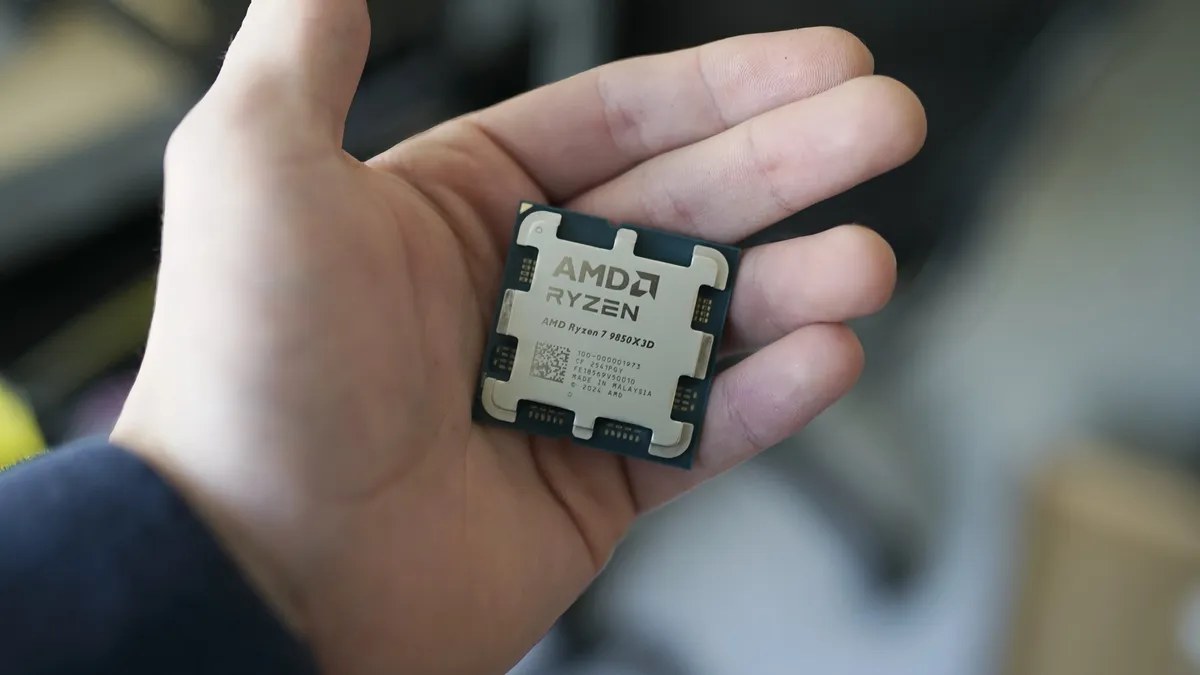
As mentioned, flicking on PBO and setting a boost override of +200MHz is about as easy as overclocking gets. Even within PBO, you have access to Curve Optimizer and Curve Shaper to squeeze as much performance out of the silicon as possible, either across all cores or on a per-core basis. And that’s before manually tuning your memory.
PBO is dynamic, so the boost override of an extra 200MHz simply allows the CPU to scale to higher frequencies if the workload demands it. It’s not a flat overclock, and that behavior is important here. As you can see consistently throughout both stock and OC performance, the Ryzen 7 9850X3D and 9800X3D top out around 5.4GHz on average in games, with only a handful of cases where they crack the 5.5GHz barrier. These chips are capable of hitting higher clocks with PBO, which I confirmed before running any games. It’s just that gaming as a workload doesn’t demand those clock speeds from these two chips.
Even lightly-threaded games like Counter-Strike 2 don’t see a linear increase as the clock speed increases. In games that scale better to higher thread counts, like Cyberpunk 2077, the differences are dulled further. And in GPU-bound titles like Doom: The Dark Ages, they disappear entirely.
Although only $20 separates the Ryzen 7 9800X3D from the 9850X3D at list prices, the 9800X3D has seen price drops in response to AMD’s latest CPU. At the time of writing, it’s available for $443, and over the past week, I’ve seen it for as little as $430. Especially below $450, it’s hard to justify the Ryzen 7 9850X3D over the 9800X3D when the latter offers almost identical performance with PBO enabled. And, although the Ryzen 7 9850X3D can climb higher, that extra clock speed doesn’t amount to much in games — in our suite, it amounts to 0.9%.
|
Motherboard |
MSI MPG X870E Carbon Wi-Fi |
|
RAM |
2x16GB G.Skill Trident Z Neo RGB DDR5-6000 |
|
GPU |
Nvidia GeForce RTX 5090 Founder’s Edition |
|
Cooler |
Corsair iCue Link H150i RGB |
|
Storage |
2TB Sabrent Rocket 4 Plus |
|
PSU |
MSI MPG A1000GS |
|
Other |
Arctic MX-4 TIM, Windows 11 Pro, Alamengda open test bench |
Above, you can see the test bench we used for this batch of testing, which is identical to the system we used for our Ryzen 7 9850X3D review in both hardware and software. As usual, we tested with EXPO/XMP turned on, ReBAR enabled, and Virtualization-Based Security (VBS) turned off.
التعليقات