
The best website builders are a one-stop platform that includes the best web hosting, domain registration, best email hosting,and everything else you need to start a website or businesses in one place.
It’s important to know that while a website builder can be the fastest and easiest way start something you are locked into the platform for the life of the website. Should you want to use a different platform, you’ll need to rebuild from scratch. If this is a concern, try hosting.
If you want an easy life with everything under one roof, pick from one of the best website builders below.
The best website builders of 2026
Why you can trust TechRadar
We spend hours testing every product or service we review, so you can be sure you’re buying the best. Find out more about how we test.
The best website builders of 2026 in full
Best website builder overall

Who is Wix best for?
✔️ It’s for you if: You want a well-rounded website builder that meets all your needs.
Wix is the most well-rounded website builder on the market. With extensive business tools and a large app marketplace, whether you want to start selling online, take bookings, launch an event, or market your business, Wix has everything you will need.
❌ It’s not for you if: You only need specific tools and features.
Although Wix isn’t the most expensive website builder on the market, it also isn’t the cheapest. If you just want your website to do one or two things well, you can usually save by going elsewhere.
Wix’s impressive business tools are one of the biggest reasons I recommend Wix so often.
These include advanced ecommerce functionality, an appointment booking system, event management tools, a restaurant reservations platform, a logo maker, and a bunch of helpful financial tools such as a pay link generator and an invoice creator.
Wix also offers helpful AI-powered features, including a text and image creator, a meta tag generator, and analytics with built-in AI that helps you identify and take action based on website trends.
Wix pricing and plans

|
Plan |
Paid monthly |
Paid annually |
|---|---|---|
|
Free |
$0/mo |
$0/mo |
|
Lite |
$24/mo |
$17/mo |
|
Core |
$36/mo |
$29/mo |
|
Business |
$43/mo |
$39/mo |
|
Business Elite |
$172/mo |
$159/mo |
Learn more about Wix
This is just a snippet of what Wix has to offer. Read our in-depth Wix website builder review to find out why it’s the best website builder on the market.
If you are looking for something cheaper than Wix, Hostinger offers many of the same tools at a lower price point. Squarespace is also a worthy alternative if website design is important to you. You can check out our full guide to Wix alternatives.
Best value

Who is Hostinger best for?
✔️ It’s for you if: You want one of the best website builders on the market at a super competitive price.
When you stack Hostinger against others that offer similar tools and features, such as Wix and Squarespace, it offers unbelievable value for money.
❌ It’s not for you if: You want to access a more comprehensive suite of business tools.
Unlike Wix, Hostinger lacks a third-party app marketplace. This can limit the functionality of your website and possible integrations with other platforms, such as email marketing software or a CRM.
The multi-lingual AI builder allows you to put a website online in just four clicks, Hostinger claims. I gave this a try, and although the results were good, the text, images, and formatting needed a fair amount of editing to make it fit for purpose. This is true of every AI website builder I’ve tested.
Outside of the editor, you’ll get all the features you would expect from a leading website builder, including an AI writer and AI SEO tool (only available on higher-level plans) as well as a bunch of simple, yet powerful ecommerce and blogging tools.
Hostinger’s website builder also comes with some helpful business tools, such as its recent integration with Print On Demand (POD) company Printful. This partnership allows small businesses to launch online stores without the need to ever purchase, manage, package, or post stock – helping unlock a lucrative new revenue stream, with minimum input.
Oh, and I love that you don’t have to pay any additional transaction fees to Hostinger, which can be a big profit drain with some website builders.

Hostinger pricing and plans
|
Plan |
Introductory offer (48 months) |
With our exclusive promo code* |
Renewal rate |
|
Premium Website Builder |
$2.99/mo |
$2.69/mo |
$11.99/mo |
|
Business Website Builder |
$3.99/mo |
$3.59/mo |
$13.99/mo |
* You can use code TECHRADAR to get an extra 10% off at checkout.
Hostinger doesn’t offer a free plan, but does offer a 7 day free trial AND a 30-day money back guarantee. You’ll need the Business plan to sell online and access advanced AI tools.
Learn more about Hostinger
Read our full Hostinger website builder review for more insight into what the platform offers.
For more business and website building tools, Wix is more comprehensive than Hostinger, but will also cost you more. Squarespace is also a good alternative to Hostinger if you want a platform that puts design first.
Best templates

Who is Squarespace best for?
✔️ It’s for you if: You want the best-looking website in town.
Squarespace is well known for offering the best templates of any website builder, and it continues to lean into that.
The company even claims its templates have won awards. I can’t for the life of me find which awards its templates have won – but if you take a few minutes to browse them, you’ll see why it’s believable.
Even Squarespace Blueprint, Squarespace’s AI website builder, creates stunning website templates that knock the socks off the competition. It puts design at the heart of the AI-powered website building process, making it unlike any other AI website builder I have experienced.
❌ It’s not for you if: You want a more comprehensive set of business tools.
Squarespace and Wix are pretty comparable in most areas. However, where Squarespace beats Wix in design, Wix offers a more comprehensive set of business tools.
This is achieved partially through built-in business features, such as Wix’s appointment booking system, which has more power than Squarespace’s version, but also through Wix’s expansive App Market that unlocks a huge range of additional third-party integrations.
I found Squarespace’s feature list impressive. I found everything I would expect from a top website builder, including SEO tools, ecommerce features, and one of the best blogging sites. I even used the Squarespace Blog app to publish and edit blog content on the go – a much better use of my commuting time than doomscrolling social media.
Business tools like invoice creation and scheduling can streamline processes, saving time and money for small businesses. So too does Squarespace’s Acuity which can be used for everything from restaurant bookings to scheduling client meetings.
Personally, I really like Squarespace’s additional platforms, such as Squarespace Unfold, a dedicated social media creation and management platform, and a link in bio creator to help drive social traffic to your site.

Squarespace pricing and plans
|
Plan |
Paid monthly |
Paid annually |
|---|---|---|
|
Basic |
$21/mo |
$16/mo |
|
Core |
$32/mo |
$23/mo |
|
Plus |
$48/mo |
$39/mo |
|
Advanced |
$119/mo |
$99/mo |
Unlike with Wix, you can sell online with Squarespace’s cheapest plan, although there is 2% fee on online transactions on the Basic plan.
A detailed overview of costs can be found on our Squarespace pricing page.
Learn more about Squarespace
Our Squarespace review takes a deep dive into everything you need to know about the platform.
Wix is Squarespace’s closest competitor. I found that Wix just edges ahead when it comes to tools and features, whereas Squarespace offers better designs. They are similar in price, too. It is worth checking out our full Squarespace vs Wix comparison to learn more. You can also get insight into other options in our Squarespace alternatives guide.
Best for ecommerce websites

Who is Shopify best for?
✔️ It’s for you if: You’re building a dedicated online store.
Although all the website builders in this guide offer ecommerce features, none (except BigCommerce) are purpose-built for online stores. This means Shopify offers next level features such as rapid checkout processes that help online stores stand out from the crowd.
❌ It’s not for you if: You’re not building a dedicated online store.
Platforms such as Wix, Squarespace, and Hostinger all offer a great set of ecommerce features, letting you sell online on much cheaper plans than those offered by Shopify.
If you don’t need the advanced ecommerce tools and features offered by Shopify, you’ll be better off picking one of these alternatives.
Shopify’s ecommerce functionality is industry-leading, that’s why I picked it for my online store.
The platform includes built-in inventory management, order processing, and customer management tools. Payment processing through Shopify Payments eliminates the need for third-party providers, though over 100 alternative payment gateways, including PayPal, are supported. Checkout is optimized for conversions, with features like abandoned cart recovery.
Shopify also comes with a bunch of super-helpful AI tools. The Shopify Magic tool id integrated across the platform and includes an AI-powered template creator, image editing, intelligent product suggestions, and automated customer service responses. Shopify Sidekick, the AI assistant, provides context-specific guidance based on your store’s data, making store management more efficient.
Shopify’s AI offering makes it stand out from its closest competitor, BigCommerce, which lacks many of these features.
Marketing tools are robust, covering SEO optimization, email campaigns, and social media integration. The platform automatically generates sitemaps, handles meta tags, and provides analytics to track performance. Built-in discount and promotion features let you create coupon codes, automatic offers, and seasonal sales campaigns.
App Store is Shopify’s secret weapon, offering over 8,000 apps to extend functionality through 3rd-party vendors. Whether you need advanced analytics, loyalty programs, or specialized shipping solutions, there’s an app for that. However, app costs can accumulate quickly, so budget carefully.
I never used Shopify for in-person selling, but its Point Of Sale (POS) integration allows seamless online/offline integration. You can manage online and physical store inventory from one dashboard, accept payments in person, and provide unified customer experiences across all touch points.

Shopify pricing and plans
|
Plan |
Paid annually |
Paid monthly |
|---|---|---|
|
Basic |
$29/mo |
$39/mo |
|
Shopify |
$79/mo |
$105/mo |
|
Advanced |
$229/mo |
$399/mo |
Shopify offers a 3-day free trial, then 3 months for $1. Large, high volume businesses can use Shopify Plus starting at $2,300/mo .
Learn more about Shopify
Take a deeper dive into what Shopify has to offer with our full Shopify review.
With simple to use, yet comprehensive ecommerce tools, Wix is a great alternative, especially if your website isn’t a dedicated online store. BigCommerce is also worth considering, it offers many of the same features as Shopify, but can be a little complex and is better suited for larger businesses. Read our full guide to the best Shopify alternatives to learn more.
Best for small businesses

Who is GoDaddy right for?
✔️ It’s for you if: You need a simple, easy-to-use website builder.
GoDaddy earns its spot as best for small business thanks to its simplicity. Thanks to its AI tools and simple to understand features, it is perfectly set up to support small businesses that want to launch a great website fast and invest as little time as possible into managing it.
GoDaddy’s excellent customer service also makes it a top pick for small businesses that may need a helping hand in making their website look and work how they want. Oh, and it’s super affordable, meaning you can keep more cash in your pocket.
❌ It’s not for you if: You have advanced business needs.
GoDaddy does simplicity very well, but it doesn’t offer the same power as the likes of Wix. If you want or need to sell subscriptions, access a large app market, have a greater level of control over design, or leverage more powerful SEO tools, you will be better off spending a little more on one of the more comprehensive website builders on this list.
Once your template is sorted, you can start adding and managing different elements on your website. For example, you can add an online store or appointment booking tool to your site. You can also set up promotions and create pop-ups to promote them (or anything else you want to promote).
GoDaddy’s suite of marketing tools is extensive and includes features ranging from SEO and digital ads to social media and email marketing. Perhaps more crucially, I found GoDaddy’s marketing tools to be some of the easiest to use out of all the best website builders.

GoDaddy pricing and plans
|
Plan |
Paid monthly |
Intro rate (paid every 1-3 years) |
Renewal rate (paid every 1-3 years) |
|---|---|---|---|
|
Basic |
$16.99/mo |
$9.99/mo |
$16.99/mo |
|
Premium |
$29.99/mo |
$14.99/mo |
$29.99/mo |
|
Commerce |
$34.99/mo |
$20.99/mo |
$34.99/mo |
GoDaddy offers a free, but limited, plan. You’ll need the most expensive plan to sell online
Learn more about GoDaddy
Read our GoDaddy website builder review for an in-depth look at all of its features. You can also discover how GoDaddy stacks up against our top-rated website builder in our Wix vs GoDaddy guide.
Best for marketing tools

Who is Hubspot best for?
✔️ It’s for you if: You want to integrate into the wider range of HubSpot tools.
If you are already using HubSpot’s other tools, such as the Marketing and Sales Hubs, it makes sense to use HubSpot’s built in website builder – doing so will allow for the seamless integration of all your sales, marketing, and website data.
❌ It’s not for you if: You want to build a more complex website.
HubSpot’s website builder has been created as an add-on to the company’s other tools. If you are building a more complex, stand alone website with multiple pages, this might not be the best option for you.
The drag-and-drop editor requires no coding knowledge, though the interface feels more complex than competitors like Wix or Squarespace. The learning curve steepens when exploring advanced features like CRM integration, but HubSpot provides a ton of documentation and tutorials for newcomers through HubSpot Academy.
HubSpot includes email marketing, lead scoring, marketing automation, and campaign management built directly into the website builder. Contact forms automatically populate the integrated CRM, creating seamless lead management workflows that typically require separate tools.
I found that the AI-powered content suite has a lot of breadth and sophistication. Content Remix generates multiple content formats from single blog posts, AI Blog Writer creates compelling articles with minimal input, and Brand Voice technology ensures consistency across all AI-generated content.
SEO capabilities go beyond basic optimization with in-editor recommendations, content planning suggestions, and comprehensive analytics. The platform automatically generates sitemaps, handles technical SEO, and provides detailed performance tracking for search-focused marketers.
HubSpot’s native ecommerce functionality handles product catalogs, payment processing, and customer insights through an integrated CRM. While not as advanced as Shopify, it provides sufficient tools for businesses selling digital products or simple physical goods.

HubSpot pricing and plans
|
Plan |
Billed annually |
|---|---|
|
Free |
$0/mo |
|
Starter |
$15/per seat |
|
Professional |
$450/mo |
|
Enterprise |
$1500/mo |
Rather than offering a stand alone plan, Hubspot’s website builder comes with its ‘Content Hub’. The prices above can vary based on several factors such as how many ‘seats’ you require.
Learn more about HubSpot’s website builder
You can learn more about the HubSpot platform with our full HubSpot website builder review.
Best for agencies and freelancers

Who is Duda best for?
✔️ It’s for you if: You run an agency.
Duda’s professional and specialized tools streamline workflows and client interactions, making it perfect for high-volume, professional web design.
❌ It’s not for you if: You have basic needs.
Although Duda offers some cheaper plans, most of its competition-beating features are only available in higher-tiered plans. If you are just building a simple website and don’t need the advanced agency tools, you’ll be better off with Wix or Hostinger.
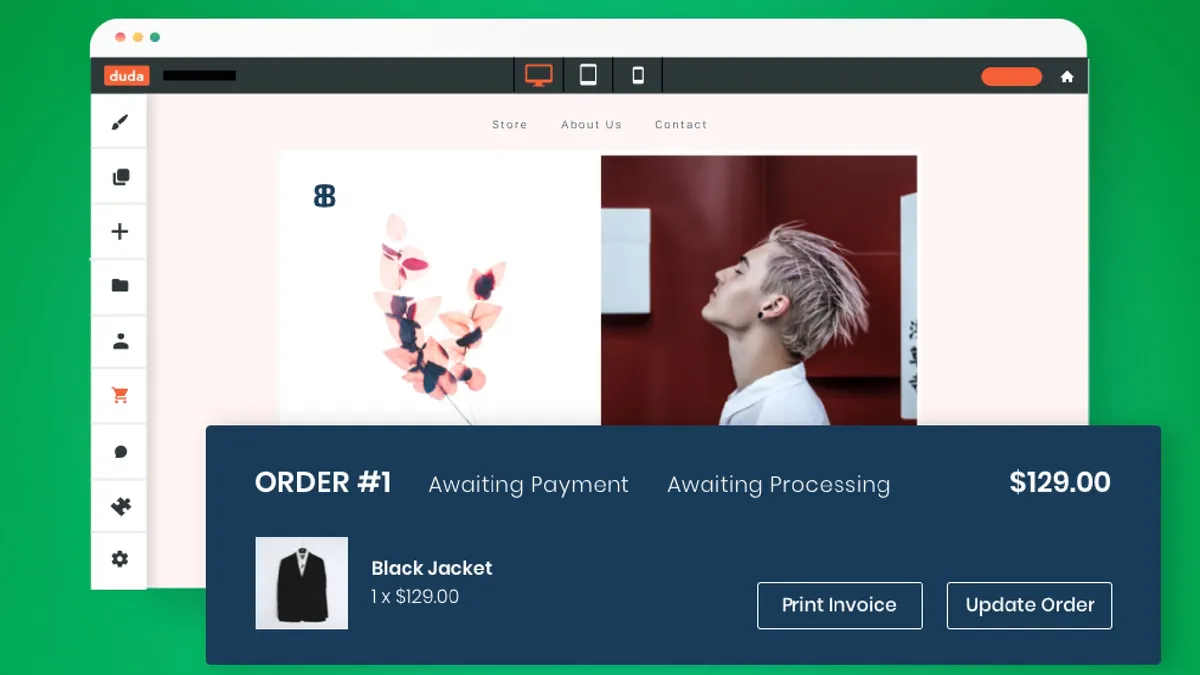
Duda’s core strength lies in its focus on client management tools.
With this, users can easily create new websites from Duda’s pre-saved templates, set permissions for clients, and even offer a streamlined feedback and revision process. All this saves significant time and resources in the workflow.
It also offers robust ecommerce tools, including various payment gateways, coupons, and gift cards. However, these features come as a paid add-on service.
What makes Duda even better for design is its customization capabilities, featuring ultra-precise edits through Flex Mode, global styles for sitewide consistency, and continuous support for RTL languages.
Plus, you even get a bunch of marketing and SEO tools, like native email marketing, blogging functionality, and comprehensive SEO features, specially optimized for Google Page Speed.
Duda pricing and plans
|
Plan |
Paid annually |
|---|---|
|
Basic |
$19/month |
|
Team |
$29/month |
|
Agency |
$52/month |
|
White Label |
$149/month |
|
Custom |
Contact for pricing |
Learn more about Duda
You can check out our Duda review for more insight into what the platform has to offer.
Best for large online stores

Who is BigCommerce best for?
✔️ It’s for you if: You plan on building a big online store.
BigCommerce is specifically designed for businesses with big needs. If you run or are launching a large online ecommerce venture, this platform has everything you need.
❌ It’s not for you if: You’re looking for simplicity.
For basic online stores, we wouldn’t recommend BigCommerce (especially if you’re a beginner) because it’s not the easiest to set up. Weebly offers a simple platform with good ecommerce features. Shopify is also a little easier to use, although it still packs plenty of power.
Offering great scalability, a host of built-in features, fantastic SEO tools, and the ability to sell across multiple channels, BigCommerce is geared towards big brands that have plenty of customers to satisfy.
In terms of drawbacks, BigCommerce’s occasional use of complex terminology might confuse inexperienced users, and its design interface can take some getting used to. Having said that, it’s still not a bad choice for smaller retailers, as it has a staggered pricing plan dependent on how many sales your site generates.
There also isn’t a full AI website builder available, which is unusual for a big player in the market, although it offers plenty of great templates.

BigCommerce pricing and plans
|
Plan |
Paid annually |
|---|---|
|
Standard |
$29/mo |
|
Plus |
$79/mo |
|
Pro |
$299/mo |
|
Enterprise |
Custom/Quote |
BigCommerce doesn’t offer a free plan, but does offer a 15-day free trial. Custom pricing is available for larger businesses with complex needs.
Learn more about BigCommerce
Read our detailed BigCommerce review for more details on pricing, features, and ease of use.
Best free plan

Who is Weebly best for?
✔️ It’s for you if: You want to test ecommerce without costs.
Weebly’s free plan includes unlimited products, shopping cart functionality, inventory management, and automatic tax calculation — features that typically cost $29+ monthly on platforms like Wix and Squarespace.
❌ It’s not for you if: You need a professional business presence.
The free plan displays Square/Weebly advertisements that can damage your brand and look unprofessional to customers. With few new tools, features, and templates in recent years, even those on paid plans can end up with dated-looking websites.
In 2025, Weebly’s free plan is a genuine surprise thanks to its ecommerce capabilities. You can sell unlimited products without transaction fees — a feature that typically costs way more on competing platforms. Unbelievably enough, it even includes inventory management, automatic tax calculation, item options, and even gift card functionality.
I found that the drag-and-drop editor handles basic website building tasks well. I could add text, images, videos, and forms without touching code. The platform automatically optimizes sites for mobile devices, ensuring content looks decent across screen sizes. However, customization options felt restrictive compared to modern no-code alternatives, and the lack of a full AI website builder is noticeable.
SEO tools come built-in, including automatic sitemap generation and basic optimization features. The platform handles technical aspects like SSL certificates, removing common headaches for beginners. Integration with Square’s payment processing creates seamless checkout experiences for customers.

Weebly pricing and plans
|
Plan |
Billed annually |
Billed monthly |
|---|---|---|
|
Free |
$0/mo |
$0/mo |
|
Personal |
$10/mo |
$13/mo |
|
Professional |
$12/mo |
$16/mo |
|
Performance |
$26/mo |
$29/mo |
Weebly offers a free plan that lets you sell online, but comes with other limits. Serious online stores will need the top-tier plan for advanced tools.
Learn more about Weebly
If you want to learn more about what the Weebly platform has to offer, check out our full Weebly website builder review.
Although Weebly is still super easy to use, it hasn’t released any major features or updates in recent years, making it feel a little dated. Wix offers a great alternative with a generous free plan, but you won’t be able to sell online with it. We have done a full comparison of the two free plans in our Wix vs Weebly guide.
Meet the expert

After spending several years writing about website builders and associated topics at Website Builder Expert, I am now the Website Builder Editor at TechRadar, where I apply my experience to recommend the best website builders for entrepreneurs and SMEs.
During my time here I have gotten hands-on experience with all of the biggest website builders, interviewed top executives from Wix, Squarespace, Hostinger, GoDaddy, and Webflow. I have also spoken and live blogged from some of the biggest industry events including WordCamp and Dudacon.
Not only do I get to test website builders as part of my role at TechRadar, I also use several of them every day, including Hostinger, Wix, and Squarespace, to build and run websites for my hobbies and side projects.
Before specializing in website builders, I achieved a BA(hons) in Business and Marketing, and had several marketing and sales role, before launching and running my own marketing agency between 2017 and 2023. During this time I worked on everything from website projects to content marketing for brands including RedBull, Dr Jackson, Cisco, Nestle, Website Builder Expert, MarketingProfs, Digital Doughnut, and NealSchaffer.com.
Website builder research and review contributor

Ritoban Mukherjee is a B2B tech and software journalist and researcher with a specialization in no-code/low-code platforms like drag-and-drop website builders, visual development tools, and AI tools for web and mobile design. His articles on website builders and no-code apps have appeared in TechRadar Pro, Tom’s Guide, Creative Bloq, and ZDNet. At TechRadar Pro, Ritoban has researched and written more than 150 reviews and guides, including website builders such as Wix, Squarespace, and Webflow. He has also tested and reviewed blogging platforms (Substack, WordPress, Medium), and ecommerce platforms (Shopify, BigCommerce, WooCommerce).
How to choose the best website builder
🚀 Define your goals
When deciding on a website builder, it’s important that you have a clear plan of what you want to achieve. Think carefully about what sort of website you are looking to create – whether text or images will be the main focus, what sort of design you have in mind, and what features you may need.
📈 Consider value for money
Price plays an undeniable role in picking the best website builder, after all, if you don’t have the budget for an expensive website builder, then it isn’t a viable option. However, once you know which options are viable, assessing value for money is crucial.
Value isn’t just a case of how many tools you get and how much a website builder costs. Take time to consider how well each tool will help you achieve your goals and drive profit. A more expensive subscription may unlock features that let you automate key processes and grow your business quickly, or it may just be bloated with features that you will never use.
👤 Test usability
When we test website builders we consider how easy they are to use. However, ultimately, how easy you find a platform will depend on your own experience and preference. A platform that is easy and intuitive to one person may be a nightmare for another to use.
Take some time to familiarize yourself with the website builder’s tools and features. Can you easily find what you are looking for? How quick and easy is each tool to use?
Take advantage of a platform’s free trial or plans to test its usability.
🛠️ Identify the features and tools you need
Website builders vary widely in the range and quality of features and tools they offer. When picking the best website builder for you, it is important to consider which tools you may need when building, managing, and growing your website.
If you are building a business website, you may also want to look at website builders that come with helpful business tools. For example, Wix offers a booking tool, restaurant reservations feature, dropshipping integrations, and helpful financial tools.
🔮 Think about your future needs
Finally, it is important to consider scalability. Although you may not need advanced business tools when you first build your website, as your business inevitably grows, so too will the demands on your website.
Of course, you can always switch website builder platforms as your business gets bigger, but this can be a costly and time consuming task. So, it’s best to plan ahead and consider your future needs where possible.
🤔 Get expert insight
If you are interested in learning more about what to look for in a website builder, I asked experts from all of the top website builders to give us their thought and insights on the subject.
Best website builder: FAQs
What is a website builder?
A website builder is a platform that provides tools for the construction and management of a website (or multiple websites) and business management.
When you use a website builder you are locked in to that platform. If you want to leave you need to rebuild and reconfigure your site from scratch. The bonus is that vendor lock-in leads to a very fast and streamlined experience. If vendor lock in concerns you, try web hosting. There are open-source page builders that allow you to build and host yourself with zero experience (they’re just not as easy as a website builder).
Typically, a website builder includes a number of templates (pre-built website designs.) The user chooses the template they like best, then uses a drag-and-drop editor to rearrange the site and add new content of their own (image galleries, videos, maps, forms, social media feeds – whatever else is available.)
With a good website builder, you can create anything from a few simple personal web pages, to a complex business site and even busy and full-featured web stores.
You can read our detailed what is a website builder guide to find out more.
How flexible are website builders?
Website builders offer a much greater level of flexibility, although how much will depend on the platform you pick. Many website builders will now let you change everything from page layouts to tiny details like the shape and style of buttons. Some even let you edit code, to help you get the exact look you are looking for.
For full flexibility you’ll need to host your own site.
Which website builders are free?
Some of the best website builders offer a free plan. For example, Wix, Weebly, and GoDaddy from our list all allow you to build a website for free.
However, free plans do have limitations. For example, most free plans will force you to host your website on a platform branded domain, such as yoursite.wixsite.com. You may also find ads on your website and limited access to tools and features on a free plan.
Free website builders aren’t for everyone, but they do offer a great way to test a builder with no financial investment.
Can I fully customize the design of my website?
The level of customization available depends heavily on the website building platform you pick, as each offers a different level of access to code and design tools than the other.
Some website builders, such as Weebly, keep things very simple, only allowing you to drag and drop blocks to create the website you want. This can help you build your site quickly and easily, but it limits customization. Other, more advanced, platforms such as Wix Studio, allow you a greater level of design flexibility with advanced design tools.
If you want total ownership and control over your website’s design, coding from scratch is your best option.
Are there any hidden costs I should watch out for?
Yes. Although website builders offer an all-in-one solution, there are some additional costs that you should be aware of.
Firstly, although many website builders offer a free domain for the first year of your subscription, once a year has passed, this becomes an additional cost. It is important to keep an eye on your upcoming domain renewal, as this can add an often small, but not insignificant amount to your total website costs.
Add-ons can also add costs to your website. For example, Wix offers many free website add-ons, but also offers premium add-ons that incur a one off or monthly cost. These add-ons are a great way to extend the functionality of your website, but their use should be carefully monitored, as they can add up over time.
Is a premium plan really worth it?
Yes.
Free website builder plans are a great way to test a website building platform or business idea, but come with limitations ranging from the inability to connect a custom domain to onsite branding that you cannot remove.
Opting for a premium plan is a great way to create a professional site and unlock more powerful website building features and tools.
Can I switch website builders later?
Website builders make it notoriously difficult to switch to a different platform at a later date. This is arguably one of the biggest downsides to creating a website using a website building platform.
Although there is nothing stopping you from closing your account and opening another account with a different website builder or host, you may find it difficult (or impossible) to transfer key aspects of your website, such as your template, functionality, and customer data.
If you believe you may want to transfer to a different website builder in the future, it is worth taking the time to understand how easy this will be given your website builder of choice.
Do website builders use Artificial Intelligence (AI)?
Many website builders are now leveraging artificial intelligence to help customers build better sites, faster than ever before. AI can be applied to many parts of the website creation process including image creation and edits, written content generation, and applying Search Engine Optimization (SEO) best practices.
Some of the best AI website builders, including Wix, Hostinger, and GoDaddy allow users to generate fully customized websites by providing a handful of prompts to an AI assistant. This can be a great way for business owners to get a head start on building their websites.
How much does a website builder cost?
There is no straightforward answer to the question: “How much does a website builder cost?” For businesses that are satisfied with simple templates and are happy to put up with ads and a generic URL, website builders can be found that don’t cost anything at all. Of course, most brands would not be content with a free solution, which can deliver sites that look unprofessional. The good news is that there are some very effective website builders out there that are reasonably priced. Most work through a monthly billing system, with costs for entry-level plans sometimes as little as $6 a month.
One thing that all website administrators should be aware of, however, is how much website builders charge for additional features. Even if your basic web builder package is cheap, costs can quickly escalate if you have to buy add-ons for security, e-commerce functionality, and marketing tools. It is important that businesses have transparency when it comes to the expenses related to their website, so it’s probably a good idea to research prospective platforms thoroughly before making your choice. It’s also important to factor in whether your website builder is scalable: will it remain suitable as your business expands and how will costs increase?
Do I need to know how to code to build a website?
No website builders require any coding knowledge. These platforms offer a combination of drag and drop and AI builders, making it simple for anyone to build a website.
However, some website builders now allow you to edit certain aspects of your website’s code, helping offer greater flexibility for more advanced users.
How hard is it to build a website?
It may sound like a daunting prospect, but building a website is not necessarily difficult – although of course that all depends on how hands-on you want to be, the type of website you want, and your level of experience. Fortunately, many website builders are designed to appeal to the absolute beginner, coming with drag-and-drop editors that mean no coding experience is required at all. In fact, most web builders will have you up and running with a fully functioning site in under an hour. Alternatively, individuals with greater financial resources could hire a professional web designer to build their website for them.
For those that are willing to take on the website building process themselves, the level of difficulty involved will depend on the website builder they choose. Although all of them are relatively intuitive, some come with extra features that may require some knowledge of the website-building process to implement. Fortunately, most platforms come with decent levels of support, including how-to guides and video tutorials. It is worth mentioning, however, that many of the simplest website builders come with limited customization. For anyone that truly wants complete control over their site, some coding experience, as well as prior knowledge of HTML, will come in helpful.
What is the best website builder for beginners?
The best website builder for beginners is Wix. This is simply down to the fact that Wix’s website builder is extremely straight forward and easy to use. Wix also has regular offers and discounts for beginners. Building a web store with Wix is very simple. as you won’t need any coding experience. Wix is also the best small business website builder for these very same reasons.
If it’s your first time building a website, you will want to commit to a website builder that’s effortless to use. Wix fits the bill, letting you build and publish a website in minutes. Wix also has an AI website builder that will ask you some broad questions about the type of website you want to create. Wix will then give you a website shell tailored to the type of website you want to create, based on the answers you give to the questions.
Beginners may also opt for Weebly for its super simple interface, or Squarespace if looking for better design tools.
Can I scale my website with a website builder?
Yes! The majority of website builders will allow you to seamlessly scale your website as you grow. This typically means upgrading your package. Doing so provides you with access to more advanced tools and extra storage, helping your website to cope with and manage greater visitor numbers and the demands they put on your site.
Even if you outgrow the top publicly available plan, many website builders also offer bespoke, enterprise level support. Before you invest too heavily, it is worth checking how your website builder of choice could support your future growth.
How can I save on my website builder subscription?
Most of the best website builders accept discount codes for the initial sign up period. We have a team dedicated to finding the best promo codes for the top website builders, including Squarespace promo codes, Hostinger promo codes, Wix promo codes, GoDaddy promo codes, and Bluehost promo codes.
Are website builders secure?
Yes, the majority of website builders will come with at least a level of security built in such as HTTPS and SSL protocols. These types of protocols ensure that communications between your website and its visitors are secure by using encryption.
High levels of security help your visitors feel safe when using your website. This is especially important when dealing with sensitive information such as personal and credit card data.
Check with your website builder of choice what level of security they offer as part of their packages.
التعليقات